Whisky

Three Late Night Classics

AfterworkClassics_Sepia_Highlights

I’ve posted before about stress begetting nightcaps. Most people who work in an office, at one time or another, are stuck there post 9:30pm, working on something contemptible. Usually when that happens to me, I find myself hissing an Arya Stark style list of people responsible for my inability to relocate to a couch.

Alternatively however, I sometimes find myself up late, working on something interesting. This can happen at work, though I suspect it’s more common for people working on self driving cars at Google X than, say, for junior auditors at big accounting firms. I find it happens quite a bit at home; you’ve got a great idea, and you’re in the mood let your imagination soar like an eagle of genius on an updraft of inspiration, effortlessly floating above an ocean of tenuous metaphor.

When this trifecta of awesome occurs (it’s a trifecta; I will not tolerate people pointing that it isn’t), you need a drink that will fuel your flight. Assuming you made it through my protective barrier of wankery, below you will find the Functional Alchemist twist on three classic cocktails that we find rather perfectly compliment an evening of artistic endeavour.

Tip: Dispose of any poetry you write before heading to bed, and logout of Facebook before your first drink. Neither bare reckoning in the cold light of day. Also, if your style of inspiration involves dramatic hand gestures, use paper rather than your laptop to document your thoughts.

Hanky Panky

The Hanky Panky is a classic from Harry Craddock’s Savoy Cocktail Book. It is attributed to Ada Coleman (probably the most prominent female entry in mixology’s lopsidedly male history), who was the head bartender at the Savoy from 1903 to 1923; a remarkable feat given the time. The drink is, in it’s original form, one of the finest drinks I’ve ever tasted.

Here I’ve toyed slightly with the recipe to give the drink a more citrus-y character. The Maidenii is a spectacular semi-sweet vermouth which pairs the usual vermouth suspects with hints of strawberry gum and wattle. For the gin I’ve specified a dry London, though this drink highlights the interplay between botanicals, so any number of interesting new gins might do well. I particularly recommend the Botanist or Four Pillars.

This recipe calls for slightly more Fernet Branca than the classic two dashes, though Fernet bottles don’t have a drip insert so a “dash” could have be just about anything. I’ve also added some Cointreau, which adds a touch of sweetness and highlights the light peel notes in the vermouth. Note that they are both fairly dosage specific – the best bet is to use a 15ml jigger and try to fill it half and half with each, erring on the fernet side.

35ml dry gin

30ml Maidenii Classic Vermouth

8ml Fernet Branca

7ml Cointreau

Combine ingredients and stir over ice, then serve in a cocktail glass with a twist of lemon.

————-

Sazerac

No need to be overly descriptive here: This is what happens when you leave ordinary people in possession of herbs and fire. The blazer influence is clear and so it should be. You’d be stupid not to notice, and for that matter, to disagree.

I’ve avoided giving volumes here, as you are essentially just working on flavouring the base spirit (and can make it in any ratio you prefer), but should you choose to go with around two shots (60ml) of Rye, 10ml of simple syrup is a good starting point. The wash should coat the glass and give you something to flame, and a dash is formally given at 1/6th of a teaspoon (slightly less than 1ml), though in the case of the absinthe perhaps a touch more is needed. As always, experimentation is key.

Rye

Absinthe wash

Perchaudes Bitters

Thyme

Simple syrup

Wash an old fashioned glass in absinthe, coating the thyme. Set alight and burn off, then block the top of the glass to put out the flames. Stir rye, simple syrup and a dash more absinthe over ice, and add dash or two of bitters to taste. Serve in washed and flamed glass. Garnish with a crushed and lightly flamed slice of lemon peel and a flamed bay laurel leaf. Traditionally this drink is served without ice, however the glass will be warmish due to the flaming, so I leave that up to you.

————

Daiquiri

As an idiotic teenager making my initial forays into the world of booze, I was repulsed by daiquiris; I didn’t have bad taste, I was just stupid enough to confuse the pre-mixed, sugar and fruit monstrosities floating around with something resembling the legitimate form. Here, the ratios shown are designed to hit that sweet spot between the warmth and depth of the rum (it seems like a lot, just have some faith), the acidity from the lime, with just a touch of sweetness as a level. The coconut syrup brings a rich, if subtle, caramel note to the drink – and what’s more tropical than coconut?

75ml spiced rum

30ml freshly squeezed lime juice (if fresh lime juice is unavailable, substitute everything and make something that’s not a daiquiri)

15ml coconut sugar syrup

Combine over ice and shake well (a Boston shaker will do nicely). Serve up, in a cocktail glass.

————
The Chesterfield

Optins-for-Chesterfield_1

For the past few months I’ve been stuffing around with the concept and framework for a web app I’d dreamed up. This sort of thing requires a bit of competitor research and, in an unfortunate but (let’s face it) not unexpected turn of events, today I discovered that I’d been totally and utterly beaten to the mark by another startup. Hell, their UI even used the same colour scheme I was going for.

Now, if this was Fast Company or the Harvard Business Review that story would be the prelude to some uplifting crap about not giving up. This is a fucking drinks blog, however, and when life gets you down, we’re all about ditching shit and going to the pub. It’s a universal experience; you try, the universe politely tells you to get fucked, you recalibrate over a drink.

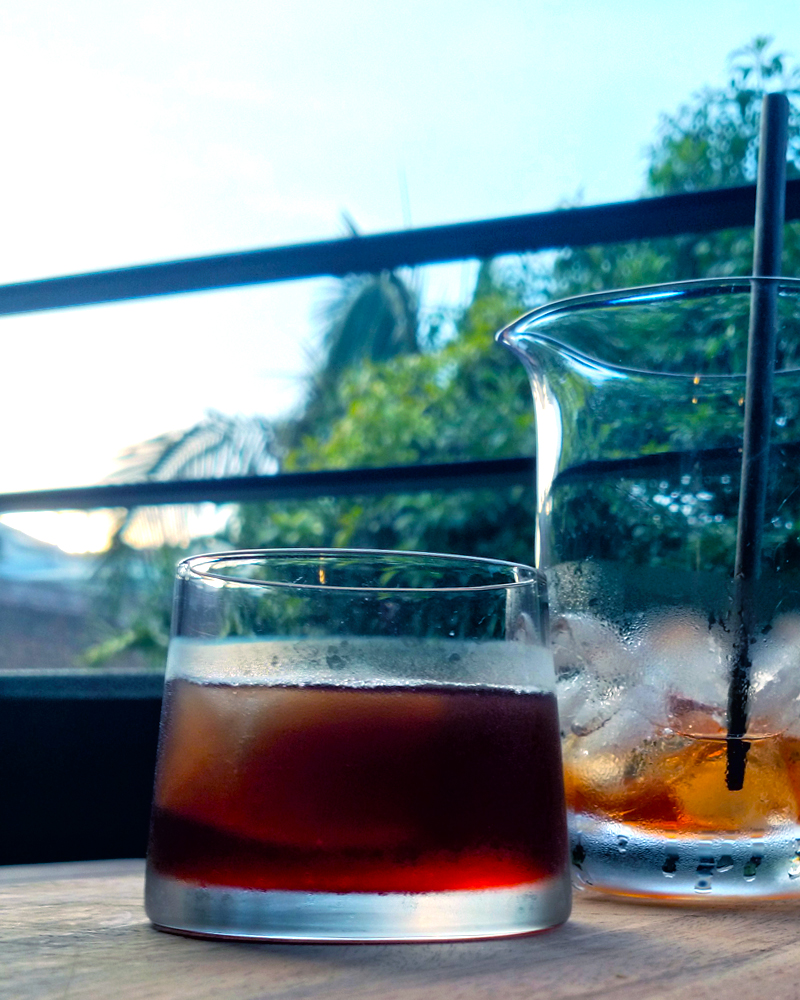
The question, then, is simple: what drink? Well, we’ve suffered said metaphorical latex fist, so I reckon something strong, and perhaps smoky and oaked. With this in mind I’ve opted for something along the lines of a Boulevardier (a negroni with bourbon rather than gin). I’ve sweetened and oaked it further by omitting the campari in favour of a traditional bitters, and by adding a pedro ximenez sherry rather than a sweet vermouth.

As a base I’ve opted for a Dickel 12, a Tennessee sour mash which has a distinct smoky finish not often found in American whiskeys. After toying with the sherry and bitters I felt the drink could use a herbal kick, so I’ve added some Dolin dry vermouth to the mix. The earl grey ice cube makes another appearance here, as I wanted a touch of bitter citrus to build through the drink as it dilutes, without using a peel garnish.

In place of an American whiskey, a lightly smoked island Scotch would work well here, (though perhaps not a full blooded Islay). Talisker would be an excellent choice, as would the pedro ximenez oaked Lagavulin Distillers Edition.

———-
The Chesterfield

45ml Dickel 12 Tennessee whiskey
15ml pedro ximenez sherry
15ml Dolin dry vermouth
1 Dash Fey Brothers Traditional Bitters
1 Large earl grey ice cube

Stir whiskey, sherry, vermouth and bitters with ice until well chilled, then pour into an old fashioned glass over the earl grey ice cube (refer here for cube instructions).
———-

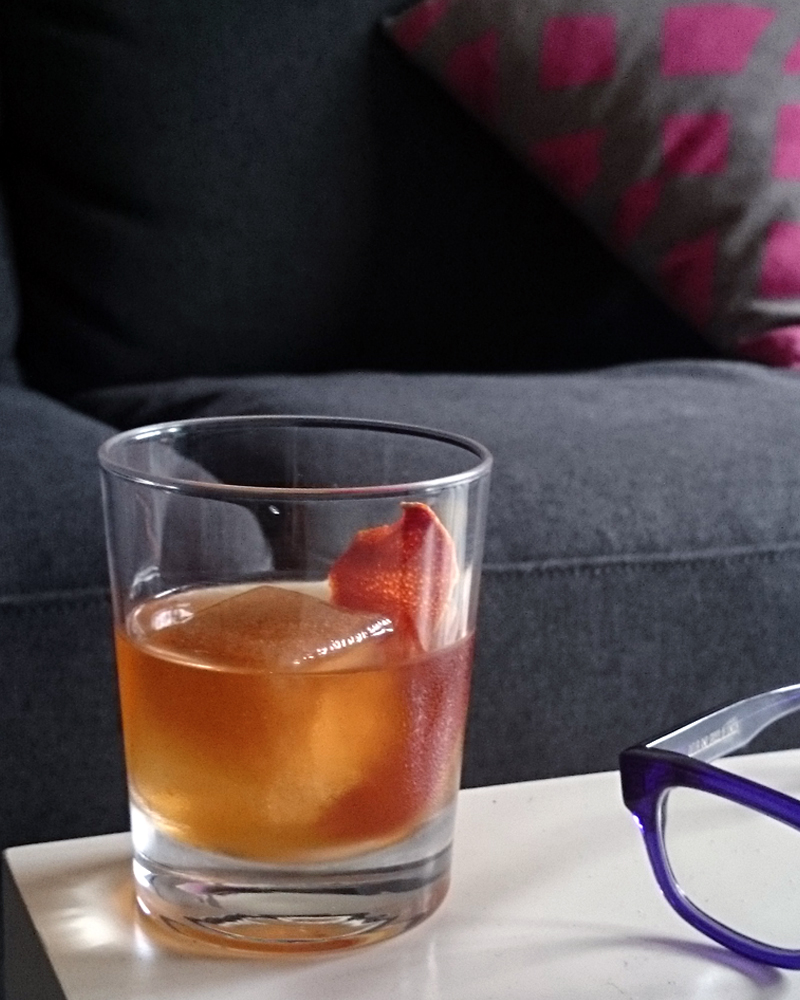
Breakfast Old Fashioned

Breakfast-Old-Fashioned

Tea based cocktails are in vogue in the artisan cocktail world right now. The factors that cause certain ingredients, styles, or methodologies to leap to the forefront of cool in a subjective art form are complicated, but my extensive research into the rise of this phenomenon has revealed that it can be traced to shut up, that’s why. Irrespective of the original provenance of the idea, the ability of tea to elevate a cocktail is almost as dramatic as its ability to plug the crumpet hole of a whining Englishman (#theAshes).

This post was meant to go up yesterday morning, when pointing out that I enjoy a strong cup of black tea on a lazy Sunday morning would have made for a thematically consistent introduction to the recipe. Instead, I’ll content myself with insulting the English and noting that standing over one’s tea while it brews is a time honoured method of winding down the office clock on a Monday afternoon. (If I was to design a cocktail for a Monday afternoon it’d be based around intravenous vodka, so let’s pretend it’s Sunday morning.)

Having skipped the background research and buggered up the theme, let’s move on to the drink itself. In my opinion, the bitter tannins of black tea combine particularly well with an aged rum or a whiskey, so we’ve used the basic structure of an old fashioned as a base. The old fashioned is a marvellously simple drink; just a base spirit, a sugar syrup, and a bittering agent mixed over ice. In effect, it’s a sort of post-mix herbal liqueur.

I’ve used Jim Beam rye whiskey as the base. Before you say anything, to make their standard white label Jim Beam’s distillers have clearly bored down into the caverns of Hades and drawn water straight from the River Styx. In the pantheon of American inventions, it shares a shelf with Fred Phelps and the Cadillacs of the 1980s. Their rye, however, is pretty damn good for the price.

To introduce the tea slowly, and change the character of the drink as it’s consumed, we’ve frozen the tea into a large ice cube. After several different teas were bandied about we settled on earl grey (we’re using a Fortnum and Mason loose leaf) for its citrus notes. To further enhance the bitter citrus character, and the breakfast credentials, our sweetener is syrup made from dissolved marmalade. As always with syrups, I advise that you use the measurements as a guide only and experiment to find your preferred sweetness.

———-
Breakfast Old Fashioned

60mL Jim Beam Rye
~20ml of Marmalade Syrup – see method for ingredients
2 dashes Fey Brother’s Original Bitters
1 large earl grey tea ice cube

The ice cubes will need to be prepared ahead of time; make a medium strength earl grey tea (ideally with a decent quality loose leaf tea), leave to cool to room temperature, and divide into an extra large ice cube tray.

Put 1 heaped tablespoon of marmalade into a small, heat resistant vessel (a ceramic mug or lipped borosilicate measuring cup) and dissolve it by pouring over 2 tablespoons of boiling water, making a simple syrup. The pectin in the marmalade can be quite resistant to dissolving, so you may find yourself needing to stir it for a while, and/or give it a brief spin in the microwave.

Once dissolved, pass the liquid through a strainer to remove the fine bits of peel you find in most decent marmalades. It is possible to leave the peel in, as it is quite tasty, but leaves the drink with a slightly odd mix of textures. Different marmalades have different sugar contents, so taste as you go to get it right. It is worth noting that you will find it easier to get the balance of marmalade to water in the syrup exactly right if you make a larger batch (the recipe makes about enough for two to three drinks).

Mix the rye, bitters and marmalade syrup over ice and pour into large, stemless tumbler. Add the earl grey ice cube and a twist of orange or grapefruit peel (fresh or dried) and swirl to combine.
———-

Shiver Me Gingers (Port Light)

As mortal creatures, bound to the inexorable march of time, the loss of the things we hold dear is an unavoidable reality. Though we may rationalise this as a natural part of the fabric of our lives, nothing can quite prepare us for the terrible realisation that a treasured relationship has come to an end. And so it was when stuntalbatross was greeted by the news that his passionfruit syrup had almost completely succumbed to a permanent low tide.

We’re great believers in the ancient Persian aphorism “if you’ve got to lose something, then you might as well be directly involved in it’s demise, and that demise might as well feature post-war, faux polynesian kitsch”, so tiki drinks involving the remaining syrup were obviously in order.

Unfortunately, we were rumless, ruling out many of the simple options, and leaving the syrup unguarded while we obtained some didn’t seem wise. We also couldn’t be arsed walking to the shop. Thankfully, however, we had bourbon at our disposal. This, plus a little research, led us to the Port Light.

First concocted in 1961 in a place sacred to tiki cocktails (Ohio), the Port Light is an interesting interpretation of a whiskey sour. For ours, we omitted the grenadine and replaced its volume with additional passionfruit syrup as we felt it sufficient to sweeten the drink, and wanted to enjoy the bourbon/passionfruit combination. This unfortunately meant the cocktail wasn’t red, and hence was no longer suitable for use as a regulation port side navigation light, though the fact that it was an alcoholic beverage rather that an IP rated water proof lamp may have already eliminated that as an option.

———-
Not Quite Port Light

45ml Bourbon (we used Maker’s Mark)
30ml Passionfruit syrup
(for a traditional Port Light use 15ml Passionfruit syrup and 15ml Grenadine)
30ml Lemon juice

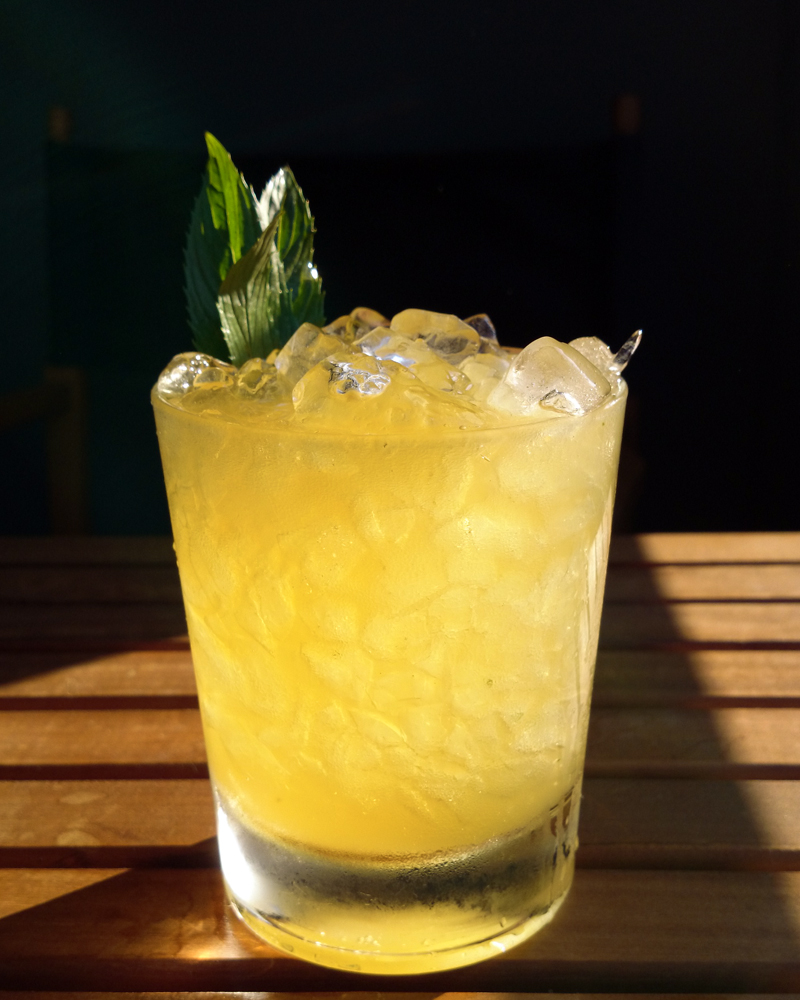
Shake all ingredients over ice, pour into an Old Fashioned glass full of crushed ice. Garnish with a sprig of mint.
———-

Armed with the knowledge that bourbon and passionfruit mix extremely well, we tried our hand at a taller drink. Mint and ginger both play nicely around passionfruit, and are right at home in a summer cocktail.

Port-light-variation

———-
Shiver Me Gingers

45ml Bourbon
30ml Passionfruit syrup
Handful mint leaves
Ginger beer (to taste)

Stir bourbon, passionfruit syrup and a couple of mint leaves with ice until well chilled, then strain into a large Old Fashioned glass filled with crushed ice. Top with ginger beer, garnish with a sprig of mint.
———-