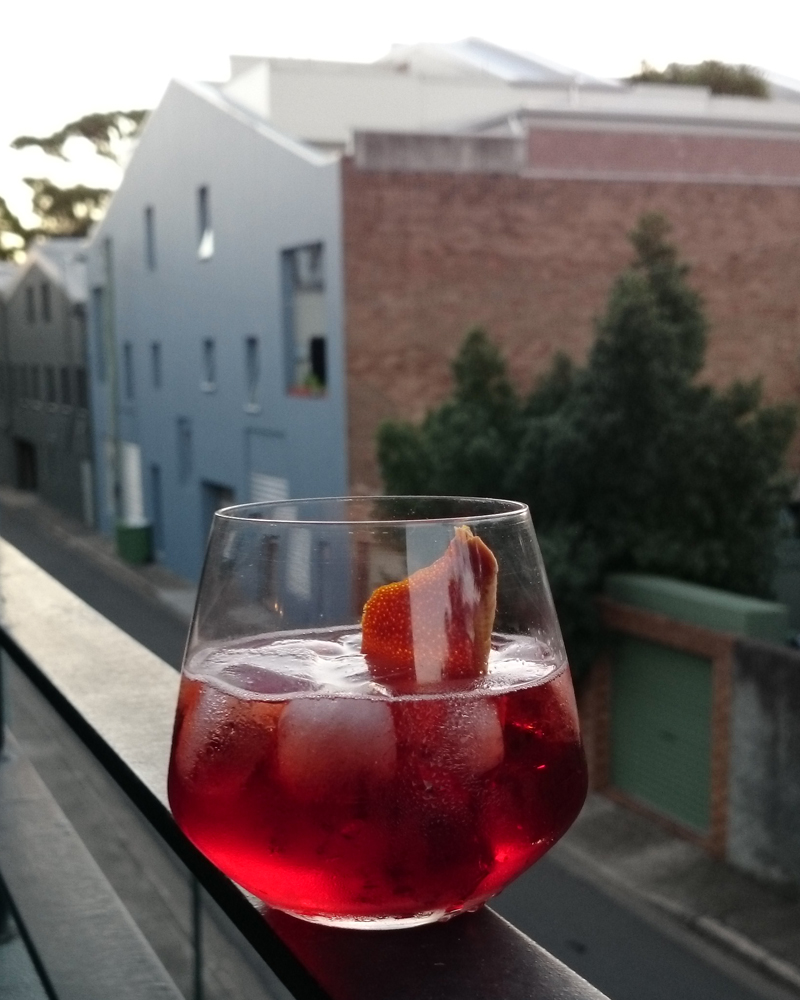
The negroni was born, illegitimate and out of wedlock, after a sordid affair between an Italian nobleman and an americano – a coupling thankfully free of his Florentine member experiencing the difficulties of navigating an awkwardly narrow bottle neck. Count Camillo Negroni, assuming my wild extrapolations from scant historical data are correct, was quite the booze hound. Only a seasoned imbiber would order a pleasant, if mild, aperitif and ask the barkeep to replace the non-alcoholic mixer with a healthy slug of gin. If he wasn’t a Count by birth that one deft manoeuvre would have assured his place amongst the nobility.
The origin story of our drink is less interesting, and much less manly. Briefly summated, we found some seemingly obscure gentian liqueur, Pagès Gentiane d’Auvergne, in a local bottle shop and thought its bittersweet, herbal flavour appropriate for a negroni. Riveting stuff.
Gentian has a strong vegetal and woody flavour that is very hard to mistake for anything else. This liqueur is potently bitter, and vibrantly yellow, so we lowered it’s volume relative to the gin and vermouth. Rosso Antico, which you might remember from such decades as the 1970s, provides ample sweetness in the fight against the bitterness of the gentian, though it is far from the most complex of sweet vermouths (technically it’s a herbal dessert wine, not a vermouth). Dubonnet, classed as a quinquina due to its cinchona bark/quinine content, was included in the mix to strengthen the vermouth side of the drink, and because quinine and gentian combine extraordinarily well (one of the many reasons Lillet and Suze work together so nicely in a white negroni).
The resulting negroni is complex and, like a Terminator timeline, difficult to describe in a rational sense. There is tension and confusion but, ultimately, resolution and great satisfaction.
———-
Auvergne Negroni
45ml gin
30ml Rosso Antico
15ml Dubonnet
15ml Pages Gentian d’Auvergne
Slice of dried orange peel
Mixed over a large ice cube in an old fashioned glass, garnish with a slice of dried orange peel.
———-
 The Functional Alchemist